TuftBot: Merging Robotics and Textile Art - ROBOTUFTART
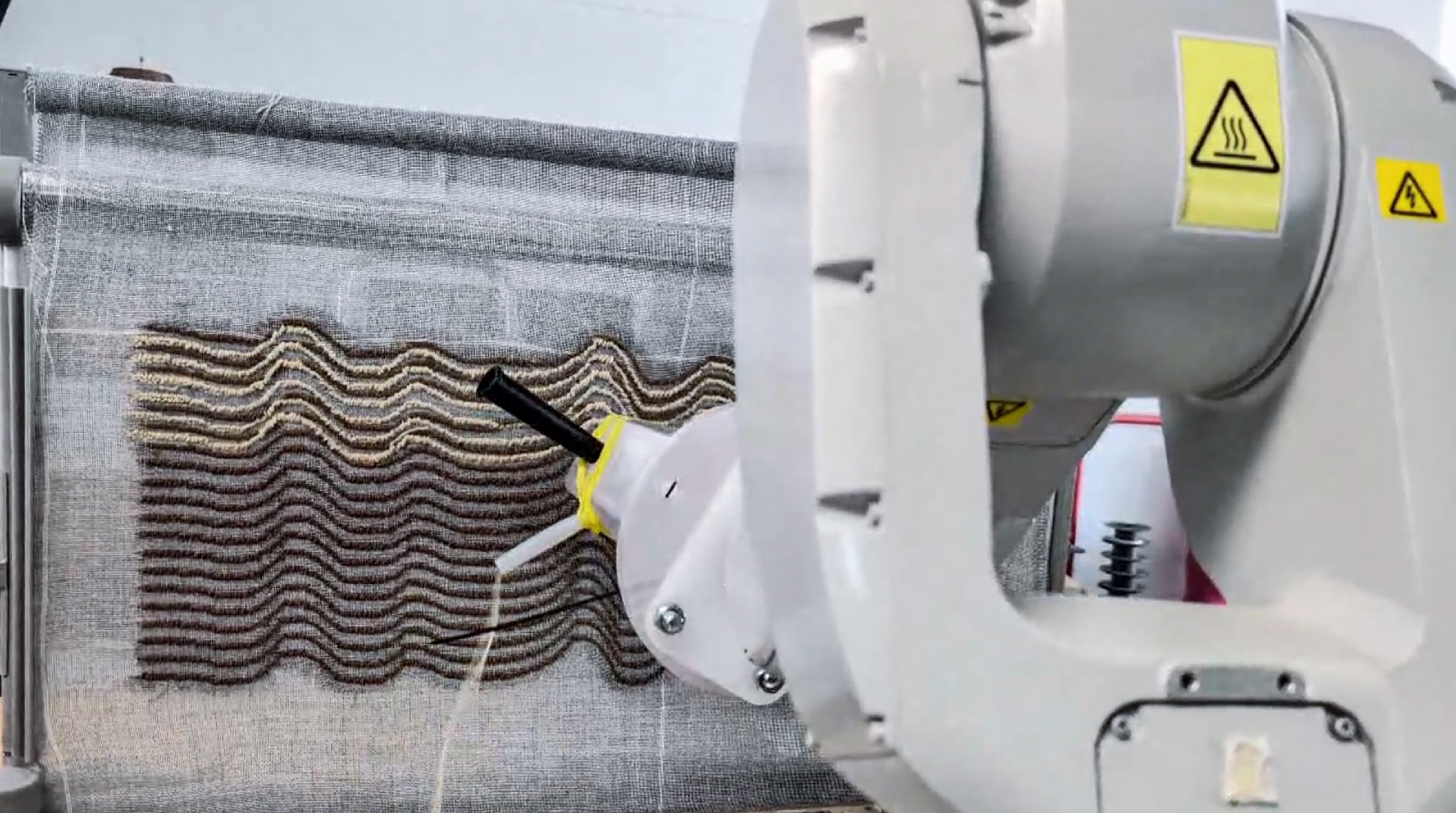
TuftBot develops a robotic tufting system optimized for Alpine coarse wool, transforming discarded regional fibers into high-value design and artistic textiles. By integrating traditional craftsmanship with adaptive robotics, the project promotes sustainable material valorization, circular economy principles, and innovative mid-tech textile production
TuftBot builds upon prior collaboration on technical validation of a robotic tufting system, which demonstrated the feasibility of processing coarse Alpine wool using robotics. The project addresses the structural limitations of conventional textile industries, which rely on standardized imported wool and exclude diverse regional fibers, resulting in large quantities of discarded raw wool.
It aims to develop an innovative production system that integrates robotic tufting with traditional wool craftsmanship, enabling an intermediate “mid-tech” approach that bridges manual artisanal methods and rigid industrial processes, offering flexibility, customization, and efficiency.
Through a modular robotic setup equipped with multi-frame tufting tools and supported by sensor-based monitoring, the project optimizes the design-to-production workflow for material variability. This approach enables small-scale, high-value production while preserving regional material production. By transforming discarded wool into economically viable products, Tuftbot supports circular economy principles, strengthens local supply chains, and contributes to environmental sustainability, biodiversity conservation, and innovation in contemporary textile art and design.
About
-
Team Biography
TuftBot project brings together Landscape Choreography and LowPoly Studio in a strategic collaboration combining artistic research, sustainable cultural practice, and advanced digital fabrication. Landcho is an interdisciplinary platform rooted in artistic and ecological research, cultural production, and critical engagement with technology; it explores new expressive applications of materials, develops design-oriented methods for regional coarse wool, and investigates wool spinning parameters within broader cultural and environmental contexts.
LowPoly Studio, a Madrid-based digital manufacturing and innovation company specialising in sustainable design, rapid prototyping, and advanced fabrication technologies, leads the technical development of the robotic tufting system based on Coded Wool project. It integrates robotics, custom automation, sensor systems, and digital workflows to create adaptive fabrication tools that support Tuftbot’s material-driven objectives.
This collaboration ensures a productive synergy between Landcho.eu’s design and material research and LowPoly’s expertise in digital manufacturing and robotics, enabling the project to advance both creative and technological innovation.
-
Team member list
- Zoe Romano, Landcho;
- Federico Aldovisi, Landcho;
- Emanuele Braga, Landcho
- Eugenia Morpurgo, Landcho;
- Emilia Gordini, Landcho;
- Gianluca Pugliese, Lowpoly;
- Luis Borunda, Lowpoly;
- Lorena Iañez, Lowpoly.
-
Useful links
-
Zoe Romano Biography - Landscape Choreography
Craftivist with a background in philosophy, digital and fabrication strategist, lecturer focused on social innovation, intersectional technologies, open design. Working mainly as a consultant in R&D on EU-funded digital social innovation projects like Woolshed where she developed her knowledge about the local wool supply chain. She teaches courses in various educational organisations and is the creator of interdisciplinary artistic and research projects at the intersection of e-textiles, digital fabrication and critical technologies in the context of care.
-
Federico Aldovisi Biography - Landscape Choreography
Cultural innovation strategist and project manager with a background in Management Engineering (Politecnico di Milano) and over seven years of experience in responsible innovation, impact-oriented design and participatory governance. He currently serves on the Board of Landscape Choreography, where he coordinates fundraising, strategic design and the management of European, national and municipal projects, applying the full spectrum of competencies developed through previous work in systemic consulting, combining organisational development, theory of change, impact strategy and multi-stakeholder engagement.
-
Eugenia Morpurgo Biography - Landscape Choreography
Italian designer researching the impact that production processes have on society, with a focus on investigating and prototyping alternative scenarios and products. She has been working on the potential of local wool for cultural heritage conservation during the BIO50 Biennial of Design in Slovenia. With Zoe Romano she has worked on the project Crafting Fashion with Robots, part of the European funded project OpenMaker, where they used a modified anthropomorphic robotic arm to produce on demand leather woven products. Together with Sophia Guggenberger they developed the research project Syntropia, funded by Re-fream, a project part of the STARTS programme, Horizon 2020, where they developed a model of footwear made with digital and traditional craft while designing the field where they source all the resources to produce them.
-
Emilia Anna Gordini Biography - Landscape Choreography
She lives in Milan and earned a degree in Fashion Design from IUAV University of Venice in 2024. Her thesis, titled "From Shearing to Felt: A Knowledge-Based Investigation of Wool Fiber and Its Processing Through Practical and Theoretical Experience as a Path to Awareness and Intention," was the result of a journey that began with shearing and involved manually carrying out each step of the process firsthand. This direct engagement with local rustic wool led her to the creation of a felt headpiece. Through this work, she gained a deep awareness of the strengths and weaknesses of rustic wool and as researcher in Woolshed project she continued her personal experimentation with gun-tufting carpets and tapestry.
-
Emanuele Braga Biography - Landscape Choreography
Artist, researcher, and cultural activist, co-founder of Landscape Choreography, MACAO and of the Institute of Radical Imagination, he works across art, ecology, and forms of collective organization. He has developed projects for international contexts, from museums to public space, combining performative, curatorial, and pedagogical practices. His research explores the relationship between artistic production, alternative economies, and the governance of the commons. Most recently, for Mutuogenesis (Berlin, with Jerszy Seymour and the Museum of Arts and Design / Kunstgewerbemuseum), he created tufted wool carpets and diagrams mapping artistic production processes.
-
Gianluca Pugliese Biography - Lowpoly
After a ten-year career in Aeronautics, he entered as vice president of Fablab Torino (the first in Italy), specializing in digital manufacturing and specializing in 3D printing collaborating with large companies in the development of 3D printers. In 2016 he moved to Madrid where he opened the first overseas store of the Italian company WASP, specialized in large format 3D printing and ceramic 3D printing. In 2018 he founded LOWPOLY, a company dedicated to sustainability in the field of digital manufacturing specializing in retail and interior design by creating and manufacturing showcases, stores and accessories for various brands in the world of international fashion. Building on his multidisciplinary approach, Gianluca also developed an innovative system that converts industrial robotic arms into digital tufting machines for the creation of rugs and wall tapestries. By combining parametric design tools and custom algorithms, the system can translate images and vector graphics into wool-based tufted textiles, enabling a new form of programmable, automated textile art.
-
Luis Borunda Biography - Lowpoly
Architect, researcher, and educator specialized in architectural technology and computational design with a focus on advanced design and construction methods that utilize computation and digital fabrication. His work has been centered on the development of lightweight, high-performance structures using computational techniques and digital fabrication technologies such as 3D printing and robotics, as well as the integration of sensors and other technologies into the built environment to enable real-time monitoring and optimization of building performance. Borunda holds a Ph.D. in Architectural Construction and Technology from the Universidad Politécnica de Madrid, where he received the highest distinction for his doctoral dissertation on digital 3D printing, design, and fabrication of continuous surfaces .
-
Lorena Iañez Biography - Lowpoly
An architect specializing in Parametric Design, Robotics, and Artificial Intelligence, she completed the first edition of the MARTE program at the University of Málaga. She holds a Degree in Architecture and a qualifying Master’s degree from the University of Granada. She achieved the highest score in a competitive selection process to develop the training, research, and support program for the General Secretariat of Housing, granted by the Regional Government of Andalusia (Junta de Andalucía). She was also a finalist in the XIII BIAU with her social project, 'Bibliokepos.'
Professionally, she works as an Architect specializing in Robotic Fabrication and Product Development. She leads international projects spanning a wide variety of typologies and scales, where design, innovation, and sustainability push the boundaries of imagination to new territories. She currently combines her professional practice with teaching as an Associate Professor at the Polytechnic School of Nebrija University.